
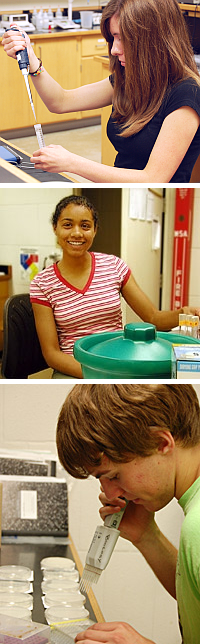
Research is how we discover our world, from cells and genes to physiology and behavior to communities and ecosystems. It's how new drugs get to the pharmacy, or new procedures to the operating table. It's how we gain the understanding to preserve our environment, grow food, screen for genetic disease, track down criminals, or live healthier lives.
You will certainly be using research in your future career—maybe as a research biologist, maybe as a doctor scouring medical journals for better ways to help patients, maybe as an environmental consultant seeking ways to plan sustainable development.
So, every Biology and Biochemistry major needs research experience—in fact, it's a graduation requirement. Here are some ways to do it and some things you should know:
- Investigating Biology, BIOL 195, is a research course that starts you on your way as you develop and test a hypothesis about what makes mosquitoes more or less likely to carry West Nile virus.
- The capstone lab, BIOL/BCHM 400L, is an independent research project in a faculty research area. This project meets your research requirement for graduation and also NCC's Career Readiness–Experiential requirement. Each semester, one lab section focuses on a cellular or molecular area, and the other on an organismal or ecological area.
- Summer research really immerses you in research! Research stipends are available; a campus-wide e-mail in February or March will tell you which faculty have summer openings.
- Students doing academic-year research with a faculty mentor can get course credit by registering for BIOL 395, Directed Research. Often, students start projects during the summer and continue during the academic year, but it may also be possible to start something new during the year.
- Talk to faculty about doing research with them if their research area interests you!
- Research can also be done off-campus through nationally competitive summer research programs (usually offering stipends and housing) or possibly internships. Some programs can be found on our Opportunities page; many more are listed by NSF and NIH or can be found using Internet searches.
- Research students present their work at North Central's Rall Symposium, student meetings like NCUR, or professional conferences. Some research students may even get to publish a paper! Papers and conference presentations are most likely for students able to do research for multiple summers or semesters.
- Our Seminar course caps off a student's research experience with a formal research presentation.